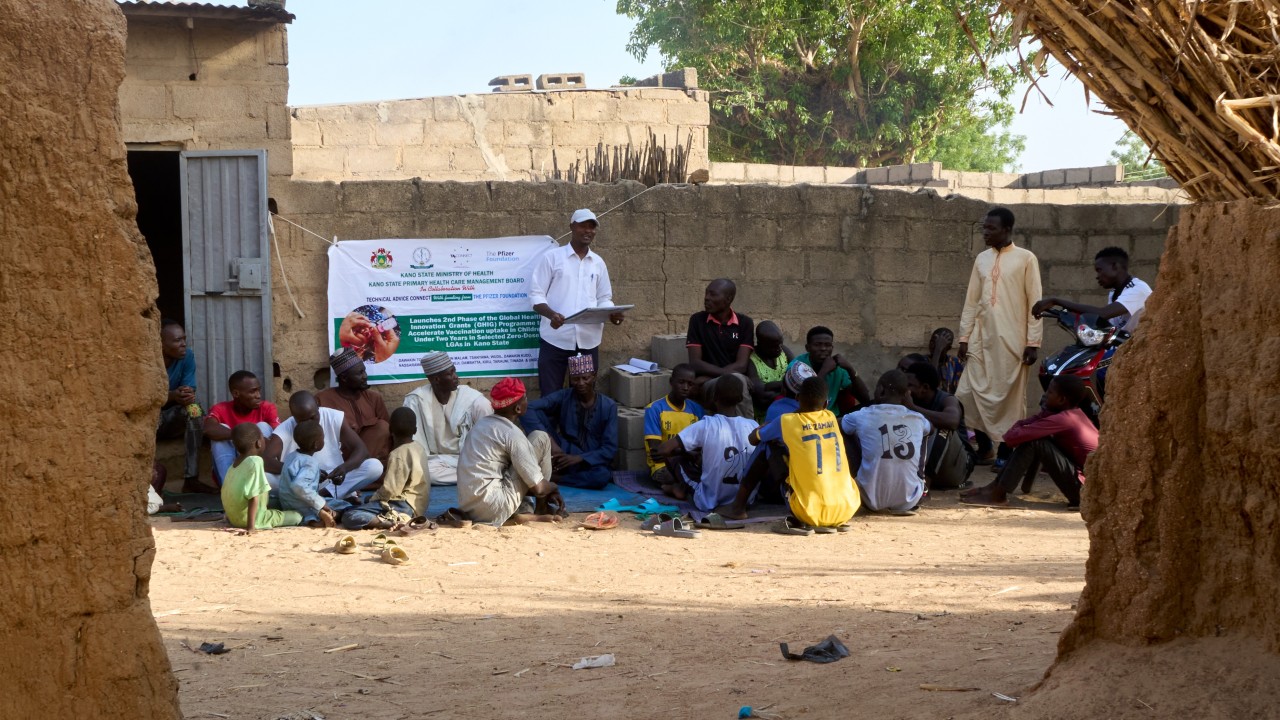
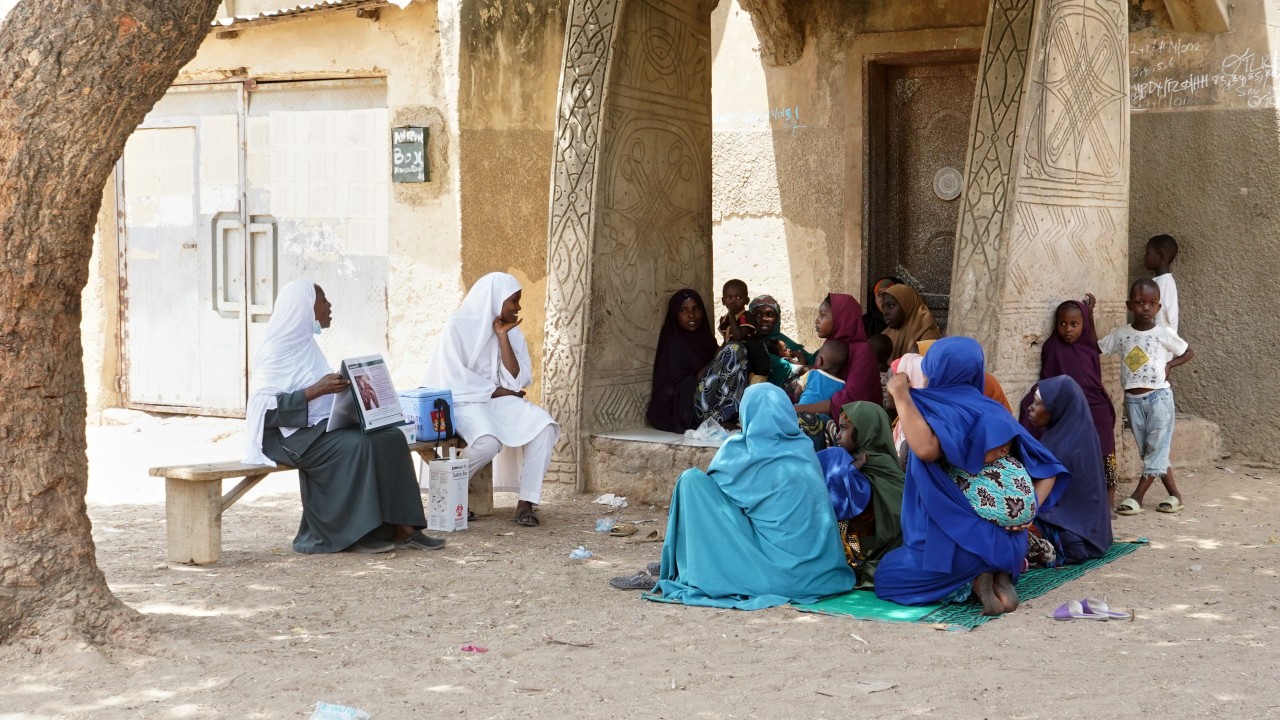
The morning sun casts long shadows across the narrow streets of Kumbotso town, a metropolitan area of Kano city where children play between modest homes and women gather at communal water points. Under the shade of a large neem tree, a circle of women sits on colorful mat, their babies and toddlers playing nearby. This is one of the community outreach sessions that has become a familiar sight in this bustling community where generations of families have built their lives around shared values and trusted customs.
Among the women, Hauwa Garba Shaibu listens intently as a health worker explains childhood vaccines, her youngest son nestled in her lap. The sight of her active participation would have been unthinkable just over a year ago. Back then, she would have found an excuse to avoid such gatherings entirely.
“I had not agreed to it before,” Hauwa admits, her voice steady but reflective. “But now, I not only take my son, I also teach others to do the same. I’ve seen what happens when children miss their vaccines.”
Her transformation mirrors a quiet revolution unfolding across Kano State, where 15 of Nigeria’s 100 highest-burden zero-dose communities are fighting back against decades of vaccine hesitancy, cultural resistance, and systemic barriers that left only 10% of children fully immunized and 30% completely unvaccinated.

Northern Nigeria has long struggled with some of the world’s lowest immunization rates, with Kano State bearing a particularly heavy burden. Historical mistrust of vaccination campaigns, rooted in past controversies and misinformation, combined with geographic isolation and limited health infrastructure, created a perfect storm that left thousands of children vulnerable to preventable diseases. By 2023, Kano held the unfortunate distinction of having more zero-dose local government areas than any other state in Nigeria—15 out of 100 nationally. (Nigeria Zero-Dose Situation Analysis,2023)
To move the needle, TAConnect, with funding from the Pfizer Foundation and working with the Kano State Primary Healthcare Management Board, took an unfamiliar approach to immunization. Instead of waiting for families to travel to distant health centers, they brought services directly to the communities through targeted community outreaches, compound meetings and dialogue sessions like the one Hauwa now attends regularly. This grassroot approach, combined with listening sessions with mothers like Hauwa, traditional leaders, and frontline health workers, helped them understand the real barriers keeping children from life-saving vaccines.
For Hauwa, the breakthrough came not through lectures or mandates, but through the intimate setting of these community outreach sessions. Health workers didn’t arrive as strangers with clinical instructions, they came as neighbors, sitting with women in their compounds, sharing knowledge – immunization, hygiene (WASH), family planning and nutrition while children played at their feet.

“I used to think it was normal when a crawling child picked things from the ground and became sick,” she recalls. “Now I understand it’s from lack of cleanliness. I’ve learned how to stop my baby from picking things and how to properly breastfeed and care for him after feeding.” Even her views on family planning shifted through these gentle conversations: “I used to fear the idea of inserting something in the womb. But now I understand it’s safe, and I explain that to others too.”
The outreach approach transformed access itself. “Before, if you’re asked to go far for vaccination, it’s difficult,” she explains. “Now, with the outreach, they come closer. You can still do your chores and get your child vaccinated. It has made life easier.”
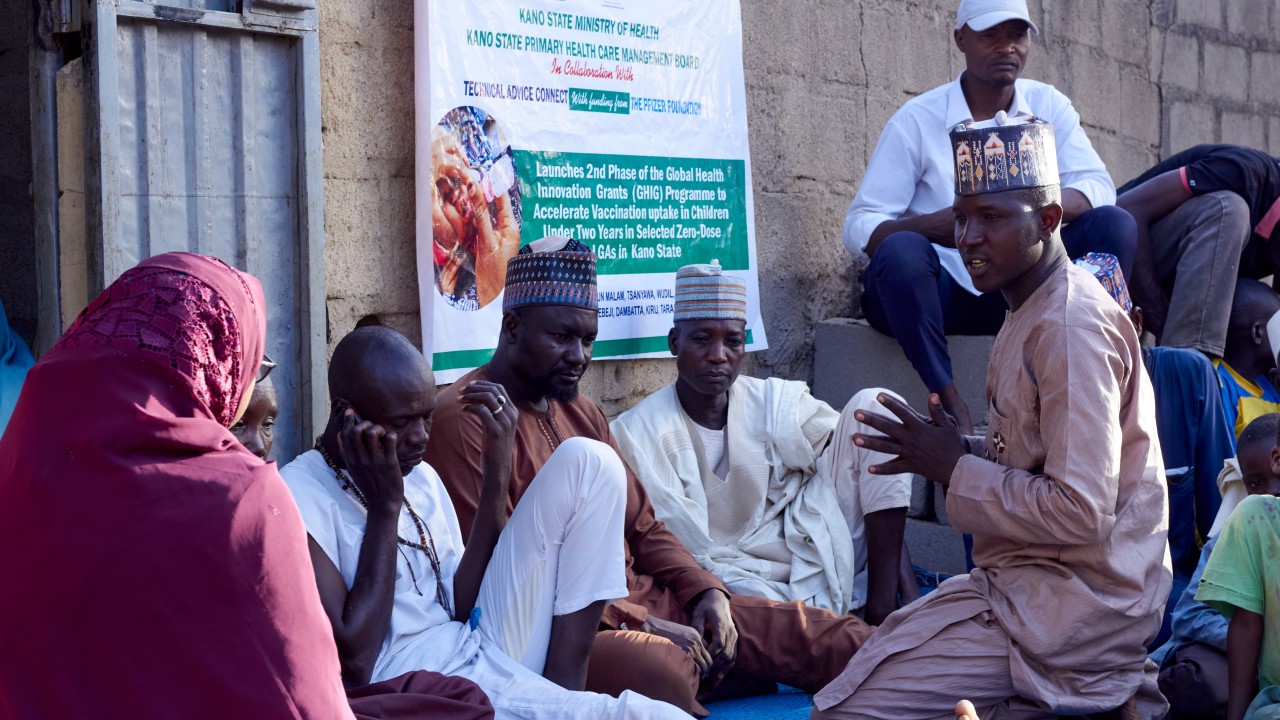
But perhaps the most powerful change came through community dialogue sessions led by respected traditional leaders like Sarkin Fulani Aminu Iliyasu, who worked hand-in-hand with the outreach teams. These weren’t formal meetings in government buildings, but conversations in family compounds and community centers where trust could be built naturally. Where vaccine fears were once whispered and myths spread unchallenged, now trusted voices are creating spaces for honest conversation during these regular outreach visits.
“Before, people didn’t see the importance of immunization,” Sarkin Fulani reflects. “They feared the injection, some said it caused fevers or swelling. But with the education brought by the outreach program, things have changed.” The transformation happened organically through these community-based sessions: “Someone may want to do it but doesn’t know how. But after attending a discussion, he’ll go back to his home and explain what he learned. From there, it spreads. One woman tells another. One family influences another.”
Mobilization for community-based outreach also addressed practical barriers that had long kept families away from health services. “Many parents couldn’t even afford the transport to a health center,” he explains. “But when you bring it to their streets, to their doorsteps, they no longer have to choose between feeding their families and protecting their children.” His gratitude for the intervention runs deep: “They’re not from here, but they came to help. They saw the need to support us even though they don’t suffer our diseases. They gave freely, with no expectations. May God increase them.”

At the heart of this transformation was a recognition that immunization couldn’t exist in isolation, and that the community outreach model allowed for comprehensive service delivery. When health worker Fatima Abubakar began participating in these house-to-house visits and community sessions, offering not just vaccines but comprehensive health education, nutrition counseling, and family planning services all in one visit, the impact multiplied. The challenges were real in those early outreach sessions: “When we started, many fathers refused to let their children be immunized. The mothers believed in the vaccines, but some had to sneak out and beg us to inject their babies quickly before their husbands returned.”
But persistence and patience during these community visits paid off. Fatima recalls one particularly difficult encounter during a compound visit: “There was one woman who yelled at us. She said, ‘They’re my children! You won’t touch them!’ We were patient. We explained. Weeks later, she came on her own and completed every round of immunization. On the last day, she brought us spinach to say thank you.”
The comprehensive outreach approach made all the difference. “You’ll see a malnourished child, we don’t even have a nutrition unit here, but we refer the mother. We talk to her about food and breastfeeding. When she comes back, the baby is better. That’s the power of these sessions,” Fatima explains. Now, the relationship with families has transformed completely through this community-based approach: “Those same families now call us. They trust us. They come not just for vaccines but for guidance. Now they call me early in the morning, ‘Aunty, have the vaccines arrived?’ and when they do, they come immediately.”
Trust Built on Doorsteps, Change Spreading Like Wildfire

The ripple effects have been extraordinary. Fathers who once forbade their wives from taking children for vaccines now call the clinic themselves. Mothers who used to sneak out for immunizations now openly advocate for them. Health workers who faced verbal abuse now receive grateful gifts of fresh vegetables from families they’ve helped.
For Auwal Idris, Program Manager of the State Emergency Routine Immunization Coordination Center, the numbers tell the story of transformation, but the approach made the difference. “We’ve always had our vaccines, cold chain, and trained health workers in place,” he explains. “But despite that, cultural beliefs, misinformation, and community norms have held us back.”
The game-changer was the comprehensive strategy: “What TAConnect brought in was not just vaccines. They brought structure, integration, and innovation. From Phase 1 to Phase 2, the project moved from rotavirus alone to include all co-administered routine antigens. That was a major step.” Real-time data now flows weekly instead of waiting months for national statistics. “Now, every week, we know which facilities have submitted reports, who’s lagging, and where the bottlenecks are. We’re not waiting for national data to catch up.”
His vision for sustainability is clear: “TAConnect has become our blueprint. What they have done in 15 LGAs, we must now extend to all 44. We don’t want to stop at 15 LGAs. With or without TAConnect, we must act like TAConnect is still here. Because the children of Kano can’t wait.”
But for Hauwa, the true measure of success isn’t in statistics, it’s in her confidence to stand before other mothers and share what she’s learned. Her son Abdulhakeem is now up to date with all his immunizations: “He has taken Penta 1, 2, and 3. We came to collect the rotavirus vaccine, and his 9-month vaccination is coming up,” she says proudly.
When asked if she feels confident to encourage other women, her response is immediate: “Yes, I can stand and explain everything. I help others overcome their fear before they even get to the hospital.” Her advocacy has become a natural part of her daily life, a testament to how deeply the program’s human-centered approach resonated with her experience.
As Dr. Layi Jaiyeola, Technical Director at TAConnect, reflects on the program’s human-centered design approach, he sees Hauwa’s story as proof that sustainable change comes not from imposing solutions, but from co-creating them with communities.
“The paradigm shift with this grant was the Human-Centered Design (HCD) approach taking into account the voices of those who matter most: caregivers, fathers, mothers, service providers, and community leaders,” he explains. “Too often, programs are built in offices in Abuja or Kano. But the people we want to serve have real, nuanced needs. With HCD, we went to the communities. We listened. And we co-created solutions.”
The integration of services was equally crucial: “We called it wraparound services. For the same effort, we could deliver four times the value reaching not just the child but empowering the mother.” His broader philosophy is clear: “If you want sustainability, you don’t impose solutions. You co-create them. Local problems deserve local solutions.” “This wasn’t just an immunization project,” he concludes. “It was a model for how development programs should be designed, delivered, and sustained.”

Today, as Hauwa watches her healthy son play in their compound, she embodies the transformation that’s possible when programs are built around human needs rather than institutional assumptions. From a mother who once avoided vaccines to a community advocate who teaches others, her journey reflects the quiet revolution spreading across Kano, one conversation, one family, one child at a time.
From Outreach to Outcomes: What the Numbers Reveal
TAConnect worked alongside the Kano State Primary Healthcare Management Board, with funding from the Pfizer Foundation’s GHIG round 8 grant, between September 2024 and April 2025 to implement a high-impact, data-driven immunization intervention in 15 LGAs (10 zero-dose and 5 high-burden) across Kano State. The strategy was simple but strategic: scaling outreach sessions from one to two per week in 90 health facilities to close access gaps. This doubled service availability and improved access across project LGAs. The outcome was a measurable uptake in childhood immunization coverage, which helped to rebuild community trust in routine vaccination services across key antigens. The outreach sessions were designed and bundled with RMNCH+N services. These were further complemented by community health worker engagement and capacity building, as well as community engagement through dialogues and compound meetings.
Through intensified outreach sessions across the 15 LGAs, the project successfully reached 11,348 children under two years, effectively closing critical immunization gaps among zero-dose populations. Pentavalent coverage saw notable increases across all doses, with improvements ranging from +22% to +80% in some LGAs. Rotavirus vaccines showed even steeper gains, with up to +100% for Rota 3 in Rano LGA. Measles 1 coverage increased by as much as +83% in Minjibir LGA, demonstrating the reach and consistency of the intervention. On average, TAConnect-supported outreaches contributed 26–28% of all children vaccinated during the project period, underscoring the critical role of community-level service delivery.

The data confirms that TAConnect’s model accounted for over a quarter of all vaccinations in the intervention areas during the period of implementation. But beyond the numbers is the story of mothers walking shorter distances, of healthcare workers empowered to reach more children, of local leaders rallying their communities to embrace immunization. The project also served as a learning platform for state stakeholders, demonstrating how operational shifts, even simple ones like increasing outreach frequency can yield improvements when supported by quality data, strong partnerships, and human-centered delivery.
These results highlight the success of a human-centered design and system-strengthening approach. It also reinforces the potential for sustained impact when government, partners, and communities work together to reach the unreached.